Tractor-Based Land Leveling for Sustainable Agriculture: A Comparative Review of Three-Point Hitch Levelers and Road Boss Graders
Efficient land leveling is crucial for sustainable agriculture, optimizing water and fertilizer use, minimizing soil erosion, and ultimately boosting crop yields. This comparative review analyzes two prevalent tractor-based land leveling methods: three-point hitch levelers and road boss graders, providing farmers, equipment manufacturers, and government agencies with actionable intelligence for informed decision-making. For more on tractor operation, see tractor operation guide.
Three-Point Hitch Levelers: Precision and Simplicity
Three-point hitch levelers, directly attached to a tractor's three-point hitch, offer a precise and relatively simple approach to land leveling. Suitable for smaller projects and fine-tuning existing surfaces, they excel at creating even seedbeds or smoothing minor irregularities in existing roads and ensuring even gravel distribution.
Pros:
- Simplicity and ease of use: Straightforward design minimizes operational complexity and maintenance requirements.
- Precision: Ideal for achieving finely leveled surfaces, particularly beneficial for seedbed preparation.
- Lower initial cost: Generally less expensive than road boss graders, making them an attractive option for smaller operations.
- Low maintenance: Fewer components translate to potentially lower maintenance costs and downtime.
Cons:
- Limited capacity: Unsuitable for moving large volumes of earth or gravel; not ideal for significant land reshaping.
- Limited versatility: Primarily designed for fine adjustments rather than substantial land alteration.
- Best suited for smaller projects: More effective on smaller fields or road sections.
Road Boss Graders: High Capacity and Versatility
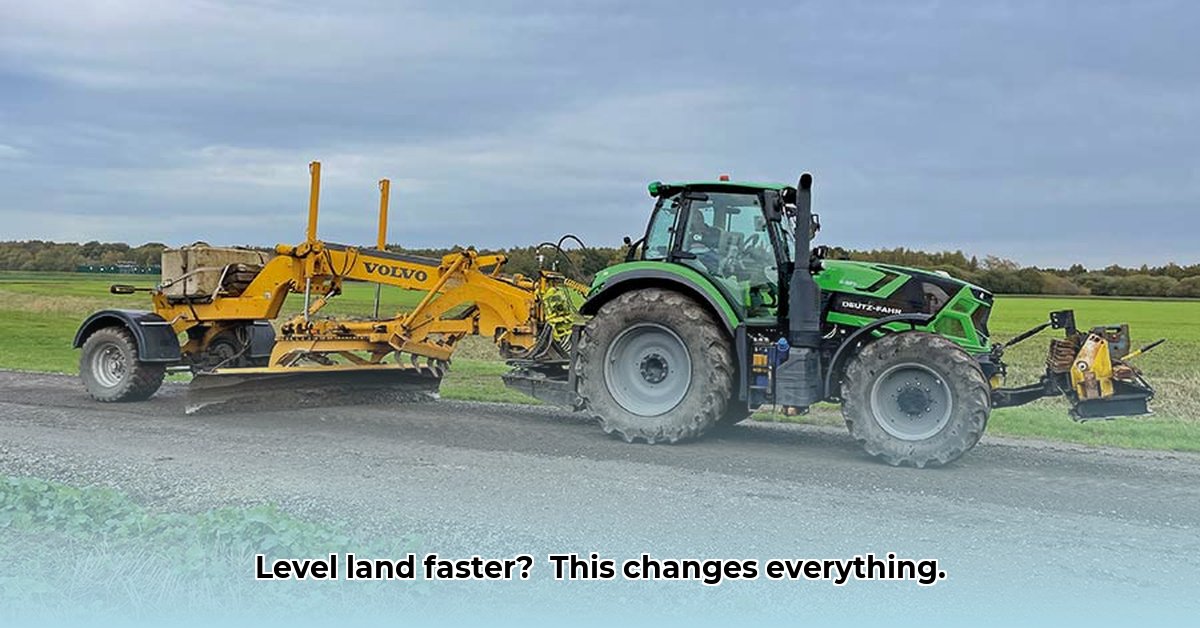
Road boss graders, heavier-duty implements towed by tractors, are designed for larger-scale land shaping and material relocation. They excel at moving substantial quantities of earth or gravel, reclaiming gravel from ditches, and reshaping extensive areas, making them especially suited for constructing and maintaining larger gravel roads.
Pros:
- High capacity: Efficiently moves large volumes of earth and gravel, expediting larger projects.
- Gravel reclamation: Effective at collecting and reusing gravel from ditches, reducing material costs.
- Suitable for large-scale projects: Ideal for significant land reshaping, road construction, and extensive field leveling.
- Versatile: Adaptable to various soil types and terrains.
Cons:
- Higher initial cost: Represents a substantial investment compared to three-point hitch levelers.
- Complex maintenance: More components increase the potential for maintenance issues and higher repair costs.
- Requires a more powerful tractor: Demands a tractor with sufficient power to handle the grader's demands.
Comparative Analysis: Key Performance Indicators
| Feature | Three-Point Hitch Leveler | Road Boss Grader |
|---|---|---|
| Initial Cost | Lower | Higher |
| Operating Cost | Lower | Higher (fuel, maintenance) |
| Capacity | Low | High |
| Precision | High | Moderate |
| Suitability (Project) | Small to Medium | Large |
| Maintenance Complexity | Low | High |
| Soil Types Handled | Most | Most, but excels with gravel |
Actionable Intelligence: Choosing the Right Equipment
Selecting the optimal land leveling equipment depends on several factors:
Project Scope: Small projects benefit from three-point hitch levelers, while large-scale undertakings necessitate the power of road boss graders. How many acres need leveling?
Soil and Terrain: The nature of your soil (clay, sand, gravel) significantly impacts equipment choice. Road boss graders are particularly suited for gravel roads. What is the composition of your soil?
Budget: Consider both initial costs and long-term operational expenses, including fuel consumption, maintenance, and potential repairs. What's your budget for both short and long-term expenditure?
Maintenance Resources: Assess your capabilities and resources for equipment maintenance. Three-point hitch levelers typically demand less maintenance. What is your comfort level with equipment maintenance?
Key Takeaway: The best choice depends on a careful assessment of your specific needs and resources.
Risk Assessment Matrix
| Technology | Potential Risk | Mitigation Strategy |
|---|---|---|
| Three-Point Hitch Leveler | Soil compaction | Minimize passes; use lighter models for sensitive soils. |
| Road Boss Grader | Gravel depletion | Implement effective gravel reclamation strategies; minimize waste. |
| Both Systems | Equipment malfunction | Regular maintenance; operator training. |
| Both Systems | Inappropriate Soil Conditions | Assess soil moisture and type; avoid working in unsuitable conditions. |
Regulatory Implications
Before undertaking any land leveling project, ensure you comply with all applicable local, regional, and national regulations concerning land use, environmental protection, and potentially water resource management. Consult with local agricultural extension offices and environmental agencies for guidance.
Conclusion
Choosing between three-point hitch levelers and road boss graders depends on a farm's unique needs and resources. Three-point hitch levelers are ideal for smaller, precision-oriented tasks, while road boss graders are better suited for large-scale projects requiring significant material movement. Carefully considering the factors outlined above, along with consulting with agricultural professionals, will ensure the selection of the most suitable equipment for efficient and sustainable land management. Further research based on your specific needs and location is recommended.